
AI Is Not Replacing Humans — It’s Replacing Directionless Effort
With this new wave of AI, many people’s first reaction is not excitement, but anxiety:
- Will my job be replaced?
- Should I change careers?
- Do I need to immediately learn a new tool, model, or buzzword?
- Every day, social media is flooded with new case studies, shortcuts, and courses, making it feel like “if you don’t keep up, you’ll lose.”
So we begin chasing courses, tools, and news obsessively, as if slowing down for even a moment means being left behind by the times.
But reality often works the opposite way: the more you try to learn quickly, the more anxious you become; the more tools you stack up, the less efficient your work may actually feel.
This anxiety is completely understandable, because AI is not merely a tool upgrade — it represents three deeper shifts:
- A redefinition of work value: Tasks once considered “professional output” — writing reports, making presentations, organizing data, translating, summarizing — are now becoming accessible to everyone. When “being able to do it” is no longer rare, what becomes scarce is the ability to do it correctly, consistently, and effectively.
- A change in how competition works: You are no longer competing with just one coworker — you are competing alongside countless people who know how to use AI. If you still rely on old methods, it’s like trying to fight automation with pure manual labor.
- Rising decision-making costs: Information overload makes it harder to identify direction; more tools make it harder to choose; faster updates make it harder to stop and integrate what you’ve learned.
When facing this situation, the mindset of The Art of War becomes highly relevant:
Victory is never determined by how fast you rush forward, but by whether you truly see the situation clearly.
The AI wave resembles the fog of war — exploding information, changing rules, more competitors, and countless possible paths.
And what Sun Tzu discussed was precisely how to make decisions in the middle of uncertainty:
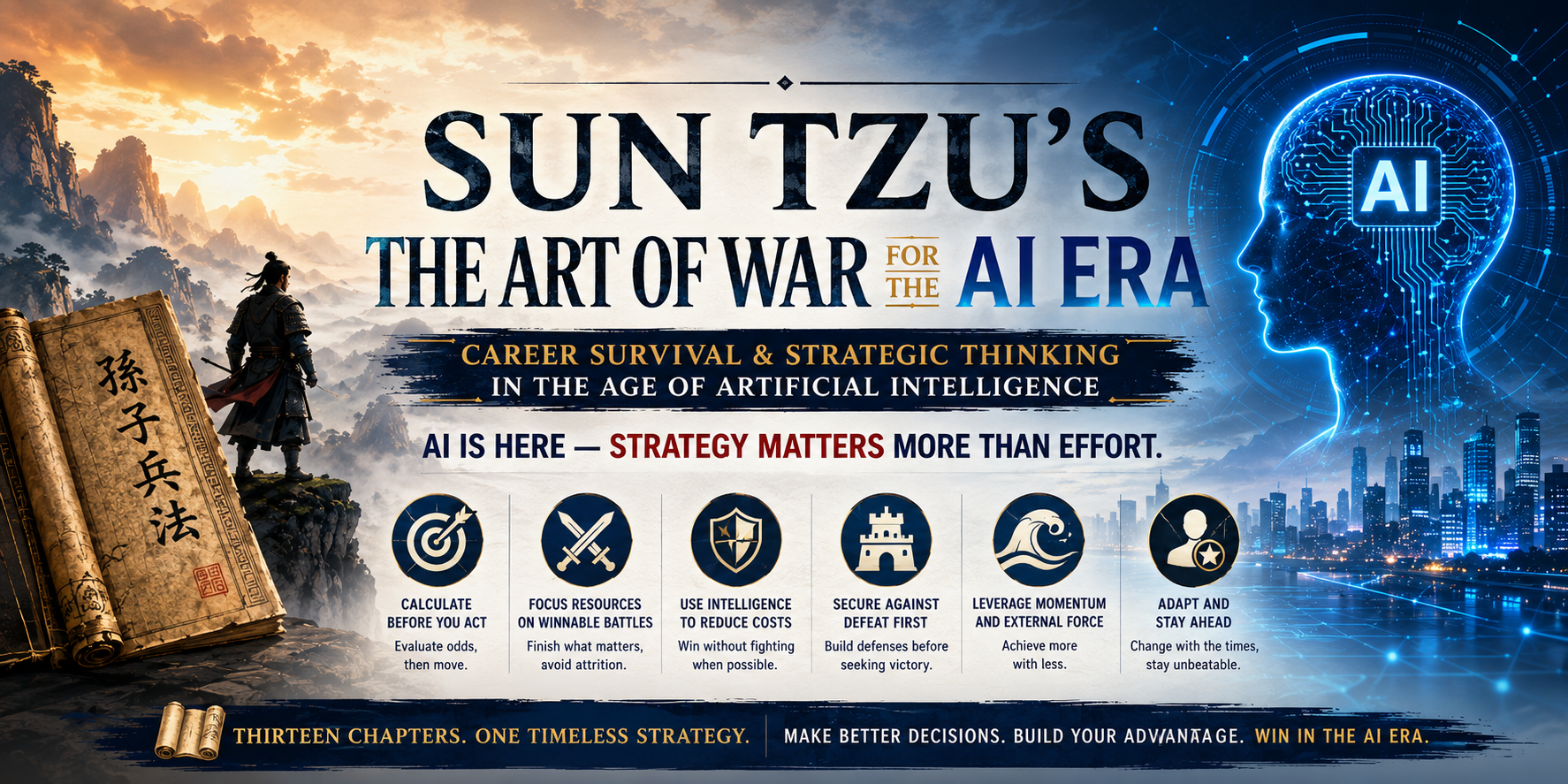
- Calculate your odds before making a move (instead of charging in immediately)
- Focus resources on battles you can actually finish and win (instead of burning yourself out)
- Use intelligence and positioning to reduce the cost of direct confrontation (instead of fighting head-on)
- Secure yourself against defeat before pursuing expansion (instead of gambling everything on a comeback)
- Leverage momentum and external force to achieve more with less (instead of fighting alone)
That’s why the biggest trap in the AI era is not “not knowing how to use tools,” but “making reckless moves.”
You invest huge amounts of time into learning that never pays off, exhaust yourself chasing every new buzzword, and drain your confidence through unnecessary comparison.
The harder you work, the more it feels like running in circles.
The true value of The Art of War lies in the fact that it does not merely teach battlefield tactics — it teaches decision-making under uncertainty:
how to reduce costs, increase your odds of success, allocate resources to what truly matters, and most importantly, “establish yourself in a position of invincibility before seeking victory.”
I previously shared a full series on the thirteen chapters of The Art of War, and in many ways, those articles already laid the foundation for the core abilities most needed in the AI era.
In this article, I’ll revisit and integrate those thirteen themes into a complete framework for navigating work and life in the age of AI.
✅ Key takeaway of this article: This is not about teaching you how to use a specific AI tool — it’s about using Sun Tzu’s thinking to build a “probability-of-winning mindset” for the AI era.
1. Initial Calculations: Calculate Your Odds Before You Act — The biggest risk in the AI era is reacting without strategy 🧭
Sun Tzu’s Art of War, Chapter One: Not About Fighting, but Knowing When Not to Act
There are countless AI tools, courses, and methods available today. But the real issue is not how much you know — it’s whether you’re applying your energy in the right place.
The spirit of the “Initial Calculations” chapter is that action should be based on evaluation and calculation, not impulse.
The most common mistake in the AI wave is turning “learning AI” into a form of anxiety-driven behavior.
People see others using ChatGPT, Copilot, AI Agents, RPA, or No-code tools and immediately feel they must catch up.
There are three especially common forms of reckless action:
- Treating tool learning as the goal itself: Seeing someone use a tool effectively and immediately copying it without a clear use case.
- Mistaking trend-following for real effort: Consuming endless AI content every day without turning any of it into your own workflow.
- Mistaking anxiety for motivation: The more afraid you are of falling behind, the more randomly you learn — until everything becomes fragmented and exhausting.
The spirit of Initial Calculations: Treat war as a system, and evaluate the odds through structured assessment.
Applied to AI, you should first ask yourself three questions:
✅ What problem am I actually trying to solve? (Pain point)
✅ What metric am I trying to improve? (Efficiency / Quality / Speed / Cost / Risk)
✅ Do I have sustainable resources and workflows? (Can this be maintained long term?)
📌 A Highly Practical “AI Initial Calculations” Checklist
- Goal: What do I want AI to improve for me?
- Scenario: What are the three most time-consuming tasks in my daily or weekly work?
- Data: Do I have usable materials (documents, spreadsheets, SOPs)?
- Risk: What information cannot be leaked or handled incorrectly?
- Results: How will I define “effective”? (For example, saving 30% of time)
Conclusion: The first victory in the AI era is not adopting the newest tool — it’s stopping yourself from making reckless moves.
2. Waging War: Can You Sustain This Battle? — Don’t Turn AI Learning into a War of Attrition ⛽
Many people fail at learning AI not because they lack intelligence, but because they mistake short-term excitement for long-term strategy.
Learning AI is like fighting a campaign: you need supplies, logistics, and rhythm.
If you switch tools every week and restart from zero each time, exhaustion is inevitable.
✅ Three Lessons from “Waging War” for Learning AI
- Choose skills that compound over time 📚
Instead of chasing every new tool, invest your time in core capabilities that work across tools and platforms, such as:- Structured communication (so AI understands what you want)
- Problem definition (turning vague issues into solvable problems)
- Verification and validation (avoiding AI-generated mistakes)
- Workflow design (turning successful outcomes into repeatable systems)
- Embed AI into your workflow instead of relying on willpower 🔁
AI becomes truly powerful when it integrates naturally into daily work:- Before meetings: generate agendas, summaries, and action items
- When writing emails: let AI create structure first, then add your tone and priorities
- When building reports: let AI organize data fields and summaries before you validate the logic
- Set realistic limits on your investment 🪖
The greatest danger in warfare is logistical collapse. Give yourself clear boundaries:- Optimize one small workflow per week
- Practice consistently for a fixed amount of time each day (for example, 15 minutes)
- Don’t aim to “know everything”; aim to “successfully build one thing”
The essence of Waging War: You are not trying to fight a glorious battle — you are trying to fight sustainably and finish the campaign.
3. Attack by Stratagem: The Highest Form of Victory Is Winning Without Fighting — Don’t Compete on the Same Battlefield in the AI Era 🕊️
The most disruptive aspect of AI is that it makes large-scale content creation and output incredibly easy. As a result, many industries are entering an era of “low-price competition.”
Everyone can write, create, and produce. Differences shrink rapidly.
If you still position yourself merely as a “content producer,” you risk being dragged into endless competition over speed and price.
When presentations, copywriting, translation, summaries, and basic analysis become accessible to everyone, what will you still rely on to win?
The thinking behind Attack by Stratagem is simple: don’t fight your opponents head-on in the same arena. Change the battlefield, change the method, change the level of competition.
Your goal is to shift the battlefield and move up a dimension.
🚀 Three Ways to “Win Without Fighting” in the AI Era
- From Creator → To Editor ✍️
As generation becomes cheap, judgment and refinement become rare:- Which sentence resonates most with the target audience?
- Which conclusion lacks evidence?
- Which risk has been overlooked?
When everyone can create content, what becomes scarce is the ability to judge quality, identify weaknesses, adjust tone, and connect with real audiences. - From Executor → To Integrator 🧩
Many people know how to use AI, but few can connect AI, workflows, and team collaboration together.
AI’s value is not only that it can “do tasks for you,” but that it can “connect systems for you.”
People who can integrate information flows, document flows, and communication flows will be far harder to replace than isolated task executors. - From Task Worker → To Problem Framer 🎯
AI can answer many questions, but the ability to ask the right question is often far more valuable.
People who can transform chaos into clearly defined problems are the ones capable of leadership, strategy, and decision-making.
The goal is not to become the person who uses AI the most — it’s to become the person who uses AI to change the rules of the game.
4. Military Disposition: Invincibility Comes First — Build Your AI Risk Defense Line 🛡️
Sun Tzu’s Art of War · Chapter 4:Being Unbeatable Is the Highest Strategic Advantage
AI is powerful, but it can also hallucinate, misjudge, and turn your data into a liability.
The core idea of “Military Disposition” is controllability.
In the AI era, your output speed may increase dramatically, but a single major mistake — leaking data, misinterpreting numbers, publishing incorrect information, or mishandling sensitive content — can cost far more than the time you saved.
The essence of Military Disposition: First place yourself beyond defeat, then pursue victory.
True professionalism in the AI era means “first avoid defeat, then pursue success.”
You can break this “invincibility” into four defensive layers:
✅ Four Defensive Lines for Staying “Unbeaten” in the AI Era
- Data Defense 🔒: Clearly define what confidential information cannot be uploaded, shared, or exposed to AI models
(client information, contracts, pricing, personal data) - Process Defense 🧱: Critical documents, public-facing communication, numbers, and conclusions must always undergo human review
(especially legal, financial, medical, and contractual matters) - Reputation Defense 📣: Avoid blindly publishing AI-generated content without review. An AI draft is not the same as a finished publication.
You must preserve your own voice, accountability, and credibility. - Capability Defense 🧠: You can outsource drafting, but not judgment. You can leverage suggestions, but you cannot abandon decision-making.
AI may help you move faster, but staying out of trouble is what allows you to go further.
True experts are not those who “do a lot with AI,” but those who can use AI extensively without creating disasters.
5. Strategic Momentum: Follow the Momentum, Win Through the Unexpected — Turn AI Into Your Advantage 🌊
The chapter on Strategic Momentum is fundamentally about leveraging force.
AI itself is a form of momentum: if you move with it, things become easier; if you resist it, everything becomes harder.
The most effective approach is to divide AI usage into two categories: the “ordinary” and the “extraordinary.”
- Use the ordinary to build stability: Apply AI to standardized, repetitive, measurable tasks (your regular army)
Examples: data organization, meeting notes, first drafts, formatting, summaries, categorization, proofreading.
These tasks are efficient, time-saving, and relatively controllable when delegated to AI. - Use the extraordinary to create breakthroughs: Apply AI to creativity, strategic thinking, and cross-domain exploration (your surprise forces)
Examples: brainstorming proposal angles, simulating objections, competitor analysis, scenario planning, risk mapping, strategic assumptions.
In these situations, AI is not there to “give answers” — it is there to expand the boundaries of your thinking.
💡 Practical Examples
- Ordinary use: meeting summaries, email drafts, report drafts, data cleaning
- Extraordinary use: market insights, proposal positioning, customer objection simulations, competitor strategy analysis
The way you use AI determines whether you are dragged forward by the wave — or surfing on top of it.
The “ordinary” increases your efficiency;
the “extraordinary” expands your strategic perspective.
When combined together, that becomes true momentum.
6.Void and Substance: Adapt Like Water — In the AI Era, Your Real Competitive Advantage Is Adaptability 💧
What AI changes fastest is not the tools themselves, but the logic of work.
What is considered professional expertise today may become a basic skill tomorrow;
the workflow you excel at today may be rewritten by automation tomorrow.
In this environment, the value of “fixed skills” may decline, while the value of adaptability continues to rise.
In the chapter on “Weakness and Strength,” Sun Tzu compares masters to water: adapting to shape, flowing around obstacles, never locking themselves into a fixed form.
✅ “Water-Like Abilities” You Can Develop
- Rapid learning and iteration: turning new tools into workflows instead of treating them as temporary novelties.
- Explaining complexity clearly: communicating through structure and clarity rather than overwhelming people with information.
- Cross-domain translation: connecting different departments and professional languages together.
- Making judgments under incomplete information: managing uncertainty while still making workable decisions.
In the AI era, “being able to do things” becomes more common — but “being able to adapt” becomes increasingly rare.
7. Maneuvering Armies: The Workplace Is a Battlefield — In the AI Era, Success Depends Less on Speed and More on Choosing the Right Path 🏁
The chapter on Maneuvering Armies teaches that even if two people reach the same destination, the cost of their chosen routes can differ dramatically.
In the AI era, the gap between people is often not about talent — it’s about choosing the wrong route and wasting enormous amounts of time on low-return activities.
🧠 You Can Simplify AI-Era Career Development into Three Layers:
- Tools 🔧: Learning how to use AI efficiently (clear short-term productivity gains).
- Processes 🧰: Turning AI into repeatable SOPs for teams (scaling your influence).
- Strategy 🧭: Using AI to assist insight, judgment, and decision-making (making yourself harder to replace).
If you are currently still at the “tool” layer, that’s completely fine — but you can intentionally move toward the process and strategy layers.
Because the higher you move, the less likely you are to fall into “anyone can do this” competition.
8. Nine Variations: Masters Are Not More Hardworking — They Make Better Choices 🧩
One of the most exhausting pressures in the AI era is the feeling that you must “get everything right immediately.”
The chapter on Nine Variations reminds us that true strength does not come from betting everything on a single path — it comes from preserving options and maintaining flexibility.
You can turn transformation anxiety into something manageable through three principles:
✅ The “Nine Variations” Approach for the AI Era
- Run small experiments before scaling up (don’t overhaul everything at once)
Start with one workflow, make one improvement, create one visible result, then expand gradually. - Prioritize reversibility before perfection (the ability to retreat matters more than flawless execution)
Choose changes that are low-risk and recoverable: for example, using AI for draft generation before human review, or testing internally before going public. - First make one task faster, then make one workflow smoother (small victories build long-term confidence)
Improving one small thing every week creates enormous differences over six months. This is far more sustainable than sprinting intensely for a month and burning out afterward.
You do not need to become an AI expert overnight — you only need one small upgrade every week.
The essence of Nine Variations is this: you are not trying to prove how impressive you are — you are trying to keep yourself continuously capable of fighting the next battle.
9. Marching: Stand on the Right Terrain and Read the Signals — In the AI Era, Learn to Read Workplace Trends 🧭
The chapter on Marching is about observation and interpretation: where water is located, where camps can be established, where ambushes may exist.
Translated into modern work life, it means learning to read workplace signals instead of investing blindly.
The AI era also has “winds” and signals worth paying attention to:
👀 Three Workplace Signals You Should Watch Carefully
- Company-level signals: Is your company adopting AI? Standardizing workflows? Prioritizing data governance and cybersecurity?
- Task-level signals: Which parts of your work are highly repetitive, rule-based, and easily automated?
- Role-level signals: Which functions are becoming more important, such as data governance, workflow integration, cross-functional collaboration, risk management, and product-oriented thinking?
The wisdom of Marching: Don’t just keep walking harder — look up and study the road ahead.
Your position determines how much effort you must spend.
10. Terrain: Hard Work Does Not Equal Victory — In the AI Era, Structure Determines Outcomes 🗺️
Many people feel frustrated by AI not because they lack effort, but because their current position is naturally more vulnerable to automation.
For example:
- Work that focuses mainly on repetitive production tasks
- Value that is difficult to quantify or easily replaceable
- Roles without decision-making authority or integration power, leaving you only as an executor
The chapter on Terrain reminds us that changing terrain is often more effective than stubborn resistance.
Changing terrain does not necessarily mean changing jobs — it may simply mean changing your role within your current work.
You can reshape your structure in three ways:
✅ Three Ways to “Change Terrain” in the AI Era
- Move from pure production roles into decision-support roles: provide judgment and recommendations instead of only delivering output.
- Move from isolated tasks into workflow hubs: manage processes, connect departments, and define standards.
- Move from behind-the-scenes execution into human influence: communication, negotiation, leadership, coaching, and coordination become even more valuable in the AI era.
You may not need to change jobs — but you may need to change your position within the structure of your work.
When the structure changes, your effort becomes easier to amplify.
11. The Nine Terrains: Understand Your Position in the Workplace — Different Terrain Requires Different AI Survival Strategies 🧱
The core idea of Nine Terrains is simple: different terrain requires different strategies.
The same applies in the AI era. Whether you are a newcomer, senior employee, manager, freelancer, or entrepreneur, your approach cannot be the same.
(1) Dispersive Ground: Your Familiar Territory, Where Retreat Is Still Possible
Workplace equivalent: You are in a relatively familiar environment. The pressure is manageable, but comfort can easily lead to complacency.
AI Strategy:
- Build fundamental workflows first: use AI for repetitive tasks and accumulate visible results.
- Create minimum viable habits: for example, optimize one workflow every week.
- Your goal is to build a solid foundation, not to show off flashy skills.
Questions for yourself:
- Do I still have enough room to steadily build systems, workflows, and portfolios?
- Have I become too comfortable to develop a second set of skills?
(2) Light Ground: Entering New Territory Without Firm Footing
Workplace equivalent: You have just entered a new department, role, or industry. You need to establish yourself quickly.
AI Strategy:
- Use AI to accelerate learning: quickly fill knowledge gaps and shorten onboarding time.
- Prioritize avoiding mistakes: establish stable processes and standards before chasing efficiency.
- Create reliable deliverables consistently so others see you as dependable.
Question for yourself:
- Am I using AI to truly understand the environment, rather than rushing to impress others?
(3) Contested Ground: Highly Competitive Positions Everyone Wants
Workplace equivalent: Competition for the same position is intense, resources are limited, and performance comparisons are obvious.
AI Strategy:
- Avoid falling into low-value competition: do not compete solely on speed or volume.
- Develop differentiated capabilities: integration, judgment, communication, and strategic thinking.
- Treat AI as an amplifier: use it to strengthen your advantages, not merely to soothe short-term anxiety.
Question for yourself:
- Am I competing to do “more,” or competing to do things “better and more correctly”?
(4) Intersecting Ground: Overlapping Interests and Constant Friction
Workplace equivalent: Cross-department collaboration is frequent, responsibilities are unclear, and teams often block one another.
AI Strategy:
- Use AI as a “consensus tool”: organize requirements, summarize meetings, and align versions.
- Create traceable workflows: increase transparency and reduce blame-shifting.
- Your role should be a coordinator, not merely an overworked executor.
Question for yourself:
- Am I stuck asking “whose fault is this”? Can I shift the focus back to “how do we solve it”?
(5) Hub Ground: The Strategic Intersection of Multiple Forces
Workplace equivalent: You deal with many stakeholders and large flows of information, making your position strategically important.
AI Strategy:
- Build a personal intelligence system: turn fragmented information into insight and recommendations.
- Use AI to accelerate synthesis and comparison: produce high-quality presentations and decision briefs.
- Your value lies in integration and judgment.
Question for yourself:
- Can I transform information into decisions, instead of merely forwarding information?
(6) Serious Ground: Deep Commitment with High Costs of Failure
Workplace equivalent: Major projects, critical clients, or important deadlines where mistakes carry serious consequences.
AI Strategy:
- Secure your defensive structure first: maintain strict data boundaries, review procedures, and version control.
- Use AI to create risk checklists: identify potential failure points and address them in advance.
- Use AI to reduce mistakes, not merely to increase speed.
Question for yourself:
- What do I need most right now: greater speed, or greater stability?
(7) Difficult Ground: Fragmented Terrain Where Progress Is Hard
Workplace equivalent: Limited resources, chaotic processes, constantly changing demands, and endless obstacles.
AI Strategy:
- Start with organization and standardization: use AI to build SOPs, templates, and FAQs.
- Stabilize before scaling: reduce chaos to a controllable level before pursuing efficiency.
- Use small experiments to find breakthroughs: do not attempt to fix everything at once.
Question for yourself:
- Am I simply staying busy inside chaos? What small standardization could immediately reduce friction?
(8) Encircled Ground: Limited Options and Increasing Restriction
Workplace equivalent: Your skills are narrow, your role is easily replaceable, and your work is highly repetitive with little room to pivot.
AI Strategy:
- Immediately build a second path: learn transferable skills such as workflow integration, data organization, or coordination.
- Use AI to build portfolios and case studies: quickly create visible results and measurable improvements.
- Actively seek external support and connections: internal transfers, cross-functional projects, or outside communities.
Question for yourself:
- Have I trapped myself in a fixed role? Do I possess a second skill set recognized by the market?
(9) Death Ground: Change Is No Longer Optional
Workplace equivalent: Organizational restructuring, industry decline, job replacement, or a point where old methods can no longer sustain you.
AI Strategy:
- Make fast decisions and focus intensely: choose the path most likely to create income or influence and commit fully.
- Trade results for opportunities: use AI to accelerate portfolios, proposals, and resume case studies.
- Prioritize action over perfection: on death ground, speed and direction matter more than flawless execution.
Question for yourself:
- Can I create visible, meaningful results in the shortest possible time to earn my next opportunity?
The greatest value of Nine Terrains is this: you stop forcing one method onto every situation.
Instead, you begin asking yourself:
“What terrain am I standing on right now?”
“Should I prioritize stability, speed, integration, or breakthrough?”
That is why Nine Terrains remains deeply practical in the AI era.
12. Fire Attack: Emotions Are Not Weapons — They Are Dangerous Fire Sources 🔥
AI anxiety usually appears in two forms:
“One day I’ll fall behind.”
Or:
“One day I’ll be replaced.”
If anxiety controls your decisions, you return to the chaos described in Initial Calculations: learning randomly, switching directions impulsively, and constantly cutting off your own strategy.
Fire Attack reminds us: fire can destroy the enemy, but it can also burn ourselves.
What you need is a psychological firewall for emotional management.
🧯 Three Practical Ways to Cool Down
- Limit information intake 📵: Set a fixed daily time to consume AI-related information instead of endlessly scrolling and exhausting yourself mentally.
- Replace anxiety with action ✅: Implement one small AI-related improvement every week. Focus on results instead of comparison.
(For example: automated meeting summaries or AI-generated proposal outlines.) - Build confidence through outcomes 🏗️: Do not chase “knowing more”; chase “building something real.” Track how much time you saved, how many mistakes you reduced, and how much output you created.
Results bring emotions back to reality.
When your emotions are stable, your strategy becomes stable too.
13. The Use of Spies: Invisible Information Warfare — In the AI Era, Intelligence and Insight Are the Most Valuable Assets 🕵️
AI has made information more abundant, but it has also made truth harder to verify.
The more you rely on AI, the more you need “intelligence literacy”: the ability to judge which sources are trustworthy, which conclusions require verification, and where blind spots may exist.
The core of The Use of Spies: victory depends on information, not brute force.
✅ What Does “Intelligence Capability” Mean in the AI Era?
- Can you identify reliable sources and cross-check information?
- Can you organize fragmented information into sound judgment?
- Can you build your own knowledge base instead of relying only on memory?
📌 Build Your Own “Personal Intelligence System”
- Create a centralized database: collect templates, SOPs, and case studies you frequently use so both you and AI can access them efficiently.
- Create decision-making frameworks: proposal structures, risk evaluation models, and decision criteria.
AI can help generate content, but the framework must be led by you. - Create a verification process: important numbers should trace back to original data, important conclusions should be cross-checked, and external content should always include human review.
While others are merely using AI to generate text, you are using AI to build information advantage.
That is what The Use of Spies means in the AI era.
14. A “Sun Tzu-Style” AI Action Framework You Can Actually Use ✅
If I had to condense all thirteen chapters into one actionable framework, I would recommend these four rhythms:
A. Weekly: Initial Calculations (10 Minutes) 🧭
- What is the single biggest pain point I want to improve this week?
- Which step can AI help reduce or simplify?
- How will I measure success? (For example: 30% time saved, fewer errors, more stable delivery.)
B. Daily: Operational Practice (15 Minutes) ⛽
- Embed AI into one workflow consistently (emails, meetings, reports, data organization).
- Save successful methods as reusable templates for future speed and consistency (prompts, formats, workflows).
C. Monthly: Strategic Attack + Terrain Analysis (30 Minutes) 🗺️
- Am I trapped in low-value competition?
- Can I shift my role toward integration, judgment, or strategic thinking?
- Should I reduce the percentage of repetitive tasks that are easily replaceable?
D. Never Forget: Defensive Structure and Fire Attack 🛡️🔥
- First place yourself beyond defeat, then pursue victory: data boundaries, review processes, and version control.
- Continuously cool down emotionally: stable emotions create stable strategies.
Conclusion: AI Is Not Your Enemy — Your Real Enemy Is “Effort Without Strategy” 🌱
AI will continue evolving. Tools will change generation after generation, and today’s cutting-edge technology may soon become basic infrastructure.
What truly retains long-term value are the abilities repeatedly emphasized throughout The Art of War:
- Initial Calculations teaches you not to act recklessly.
- Waging War teaches you how to sustain long campaigns.
- Strategic Attack teaches you not to win through brute force, but through changing dimensions.
- Military Formation teaches you to become undefeated first.
- Momentum teaches you to ride the trend instead of resisting it.
- Weakness and Strength teaches dynamic adaptation.
- Maneuvering Armies and Nine Variations teach route selection.
- Marching and Terrain teach you how to read signals and structures.
- Nine Terrains teaches accurate positioning.
- Fire Attack teaches emotional discipline.
- The Use of Spies teaches information advantage.
I want to leave you with a perspective that feels both deeply “Sun Tzu” and deeply relevant to the AI era:
Tools will change. Models will change. Platforms will change. But your quality of decision-making and adaptability will always remain your true moat.
If I had to summarize AI-era survival strategy with one line inspired by Sun Tzu, I would say:
First establish yourself in an undefeated position, then seek victory.
First protect your foundations — risk management, rhythm, and emotional stability — then gradually expand your efficiency, influence, and insight.