Category Strategy

Strategy

Wu Qi’s Art of War Explained: How to Read People, Analyze Situations, and Build Competitive Advantage in Work and Life

Two individuals strategize in a life-sized chess game, emphasizing competition and strategy.

Discover the timeless strategic wisdom of The Art of War by Wu Qi – Assessing the Enemy (Part 1) and learn how to analyze opponents, understand human nature, navigate workplace politics, and build long-term competitive advantage. This article transforms ancient military strategy into practical modern insights for leadership, career growth, negotiation, team management, and personal decision-making.

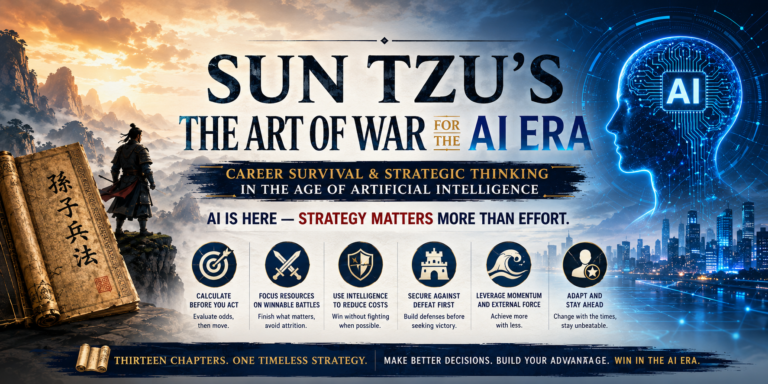
How to Avoid Being Replaced by AI: Sun Tzu’s Strategic Framework for Career Survival and Adaptability

art-ai-e0

Artificial intelligence is transforming the workplace faster than ever before. As AI tools like ChatGPT, Copilot, automation systems, and AI agents become mainstream, many professionals fear being replaced, falling behind, or losing relevance in an increasingly competitive world. But the real danger of the AI era is not AI itself — it is working harder without a clear strategy.

In this article, we explore how the timeless wisdom of Sun Tzu’s The Art of War can help professionals, creators, managers, entrepreneurs, and knowledge workers survive and thrive in the age of artificial intelligence. Instead of blindly chasing every new AI tool or trend, this guide introduces a strategic framework for decision-making, adaptability, risk management, career positioning, and long-term competitive advantage.

By reinterpreting all thirteen chapters of The Art of War through the lens of modern AI disruption, you will learn how to avoid burnout, reduce unnecessary competition, build sustainable workflows, strengthen your irreplaceable skills, and develop a “probability-of-winning” mindset for the future of work.

If you want to future-proof your career, improve your AI strategy, and remain valuable in a rapidly changing world, this guide offers a practical roadmap for navigating the AI era with clarity, discipline, and strategic intelligence.


The Art of War by Wu Qi – Planning the State (Part 2): True Leadership Is Not About Defeating Others, but Stabilizing People and Situations

Close-up of a woman arranging red miniature bowling pins on a white tabletop indoors.

Explore the leadership wisdom of The Art of War by Wu Qi – Planning the State (Part 2) through modern workplace and life perspectives. Learn how effective leaders manage conflict, stabilize teams, build organizational trust, develop talent, and maintain order during uncertainty. A practical guide to leadership, team management, workplace strategy, emotional intelligence, and personal growth inspired by ancient Chinese military philosophy.

Wu Zi Strategy Explained: Planning the State (Part 1) — How to Build Sustainable Career Advantage Through Leadership, Systems, and First Principles

manager, business, skyline, skyscraper, big city, manager, manager, manager, business, business, business, business, business, skyscraper

Discover how Wu Zi (The Art of War) reveals a powerful framework for career success beyond competition. Learn how to align people, systems, and strategy using first principles, leadership thinking, and sustainable execution. This guide translates ancient military wisdom into modern workplace insights—covering decision-making, team alignment, leadership, and long-term success strategies.

The Art of War Chapter 13: The Hidden Information War Behind Career & Life Success (Why Insight Beats Effort)

eye, light, shadow, to watch, spy, to look at, spy, spy, spy, spy, spy

In The Art of War Chapter 13: Using Spies, Sun Tzu reveals a powerful truth—success in career and life is not determined by effort alone, but by information advantage. This article explores how intelligence networks, decision-making insight, and strategic awareness can help you avoid costly mistakes, understand competitors, and win in modern workplaces and business environments. Learn how to build information systems, reduce risk, and make smarter career, investment, and life decisions.

The Art of War Chapter 12: Attack by Fire – A Modern Guide to Workplace & Life Decisions | Why Emotion Is the Most Dangerous Weapon

A vibrant and intense fire blazing against a dark backdrop, capturing the raw power of flames.

Explore The Art of War Chapter 12: Attack by Fire through a modern lens of workplace strategy and life decision-making. This in-depth analysis reveals why Sun Tzu did not advocate destruction, but restraint—showing how emotion, power, and timing can become the most dangerous “fire” if misused. Learn when to act, when to wait, and why mastering your emotions is the key to long-term success in both career and life.

The Art of War – Chapter 11: The Nine Situations | How to Identify Your Career Position and Choose the Right Survival Strategy

iceland, nature, travel, exploration, outdoors, volcano laki, ash, landscape, valley, iceland, iceland, iceland, iceland, iceland

Discover how The Art of War Chapter 11, The Nine Situations, reveals powerful insights into career strategy, decision-making, and self-awareness. Learn how to identify your current position in the workplace, avoid strategic mistakes, and choose the right actions to survive, adapt, and succeed in competitive environments. A modern interpretation of Sun Tzu for career growth and life strategy.

Sun Tzu Terrain Strategy Explained: 6 Types of Terrain & 6 Causes of Defeat in Workplace and Business Strategy

Scenic landscape of mountain ranges in Montenegro with patches of snow under a blue sky.

In modern business and workplace competition, success is not determined by effort alone, but by the structure you operate within. This article explores Sun Tzu’s Art of War Chapter 10 – Terrain, and translates its wisdom into practical workplace strategy. Learn the six types of terrain (accessible, entangling, temporizing, narrow, risky, and distant) and the six causes of failure, along with actionable frameworks such as “Know the enemy and know yourself,” “Know timing and structure,” and “secure supply lines.” This guide helps you make better strategic decisions, avoid costly mistakes, and build sustainable competitive advantage in business and career.

The Art of War – Maneuvering (Chapter 9): Workplace Survival Guide to Positioning, Reading Signals, and Working Smarter with Less Effort

Black and white photo of soldiers in historical military uniforms marching outdoors.

This article explores Sun Tzu’s Art of War – Chapter 9: Maneuvering and translates its timeless military principles into practical workplace strategies. By focusing on positioning (terrain), interpreting signals, and disciplined execution, it reveals how professionals can navigate complex environments, manage change effectively, and avoid common productivity traps.

Learn how to choose the right position, anticipate shifts through subtle signals, and build sustainable workflows that deliver consistent results. Ideal for professionals, team leaders, and anyone seeking to work smarter, reduce friction, and achieve more with less effort in today’s fast-paced workplace.

The Art of War Strategic Analysis: 20 Days of the U.S.–Israel–Iran War (2026) | Modern Warfare Meets Sun Tzu

A historic cannon displayed at Gettysburg Battlefield, Pennsylvania.

A deep strategic analysis of the 2026 U.S.–Israel–Iran war through the lens of Sun Tzu’s Art of War. This article breaks down the first 20 days of the conflict, examining military strategy, energy warfare, drone operations, and geopolitical dynamics. By applying classical principles such as “invincibility,” “speed,” and “winning without fighting,” it reveals how modern warfare reflects ancient strategic thinking—and what it means for global security, oil markets, and international politics.