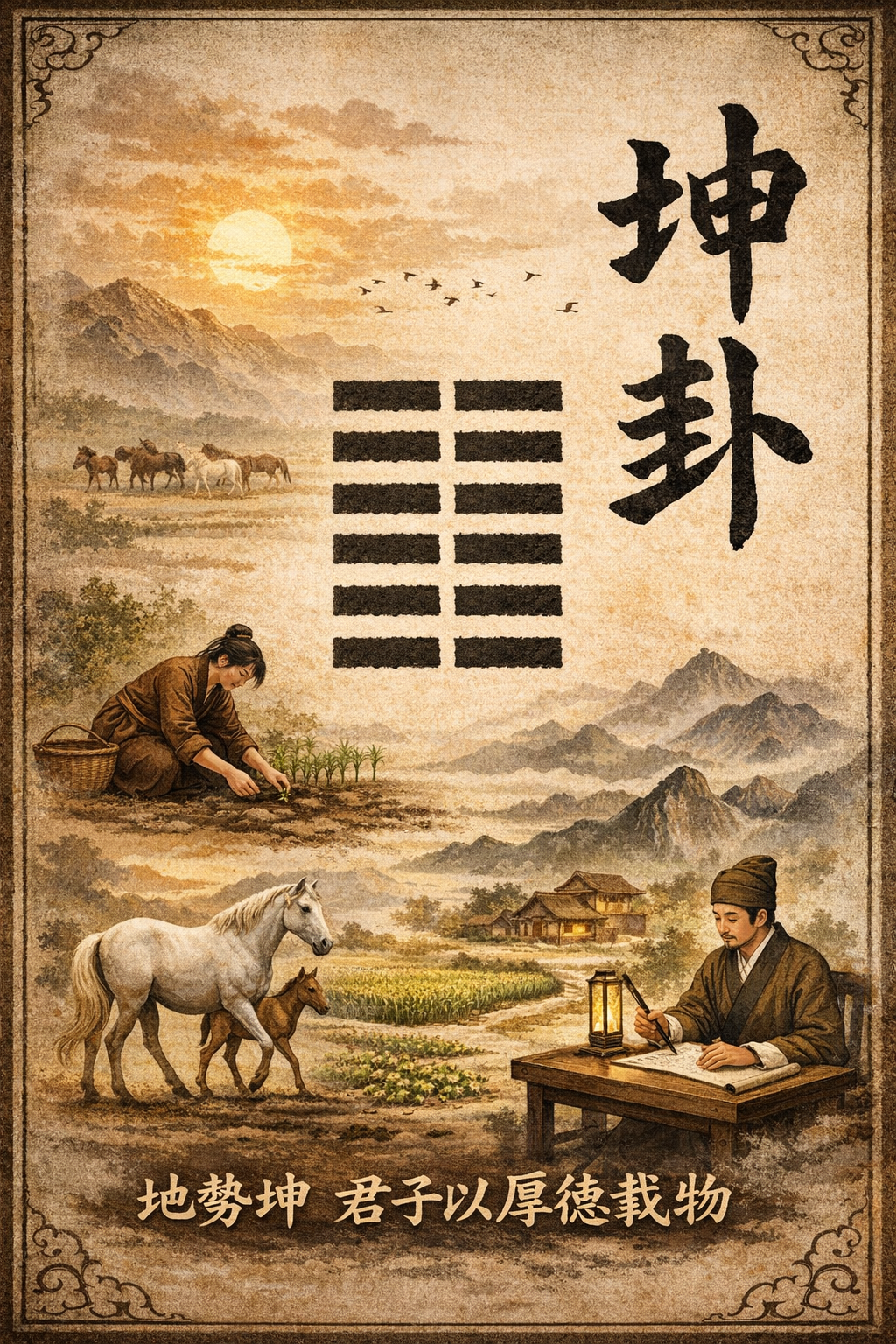

1. Why Do We Need the Kun Hexagram More in an Anxious Career?
Modern workplace values constantly urge us to be proactive, competitive, and to seize the spotlight. It often feels as if the loudest voice and the fastest mover are the winners. However, this kind of pure Qian-hexagram drive often leads to a sense of anxiety caused by a lack of long-term sustainability.
Among the 64 hexagrams of the I Ching, the Qian hexagram symbolizes initiation and leadership. In contrast, the Kun hexagram represents support, cooperation, and the nurturing force that enables all things to flourish. If Qian embodies the entrepreneurial spirit of pioneering and expansion, then Kun is the foundation that allows both organizations and individuals to endure and remain steady over time.
In the workplace, not everyone stands at the center of the stage. Yet the truly indispensable individuals are often those who embody the spirit of Kun—the ones who ensure that projects are successfully and smoothly brought to completion.
2. The Structure and Meaning of the Kun Hexagram
1. The Image of Kun
The Kun hexagram is composed of six yin lines, symbolizing the Earth.
“The condition of the Earth is receptive devotion; the noble person carries all things with great virtue.”
The Earth does not compete for recognition, does not claim credit, does not rush ahead, and does not act with impatience—yet it silently supports and nourishes everything upon it. This is the core spirit of Kun. Translated into workplace logic, we can understand it this way:
- Qian governs initiation; Kun governs completion
- Qian represents creativity; Kun represents execution and realization
- Qian sets direction; Kun provides implementation and inclusiveness
In the workplace, a Kun-type individual may not be in the spotlight, but they are the ballast that stabilizes the entire team.
2. Insights from the Tuan Commentary
“Kun: Supreme success. Favorable through the perseverance of a mare. The noble person has somewhere to go. At first confused, later finds a leader—this is beneficial. In the southwest, one gains friends; in the northeast, one loses friends. Peaceful perseverance brings good fortune.”
This passage almost fully outlines a path toward career maturity.
- “At first confused, later finds a leader”: At the beginning, do not rush to take control. Instead, discover your place through action.
- “Favorable through the perseverance of a mare”: The mare symbolizes gentleness, endurance, and a strong sense of direction—representing stable, long-term commitment.
- “Peaceful perseverance brings good fortune”: By remaining grounded on the right path without rushing forward, one accumulates genuine trust and long-term value.
This stands in stark contrast to the modern workplace anxiety that insists one must become a manager within three years.
3. Three Core Lessons from Kun for Modern Professionals
1. Supporting Is Harder Than Leading
In a mature team, the most valuable people are often those who ensure that nothing goes wrong. They bridge communication gaps, fix overlooked details, and absorb pressure.
From the perspective of the I Ching, this is not weakness—it is a highly mature form of resilience. Without the supportive strength of Kun, the ambitions of Qian remain empty talk.
Such individuals often:
- Bridge communication gaps across departments
- Handle overlooked details left by others
- Bear pressure without claiming credit
From the perspective of the I Ching, this is not a disadvantage but a refined strength. Without Kun, Qian cannot succeed.
2. Not Rushing to Prove Yourself Is Also Wisdom
The Kun hexagram does not encourage passivity. Instead, it reminds us:
When you have not yet firmly established your position, excessive sharpness can actually damage your credibility.
Many workplace conflicts arise from the urge to prove oneself right too quickly. The wisdom of Kun is:
- Listen first
- Understand first
- Move with the flow first
When the time is right, you will naturally be placed where you belong.
3. Only Great Virtue Can Support Greater Responsibility
“Carrying all things with great virtue” (Hou De Zai Wu) translates into professional behavior in the workplace as:
- The ability to embrace different personalities and perspectives
- The willingness to take responsibility for mistakes without shifting blame
- The ability to create a sense of safety within a team
Those who truly rise to higher positions are rarely just the most capable—they are the ones who make others feel the most secure.
4. Career Wisdom from the Six Lines of the Kun Hexagram
First Line (Initial Six): Treading on frost, hard ice will follow
Workplace Insight: Small issues are often the warning signs of major crises
When you first enter the workplace or join a new team, do not overlook the “frost” hidden in systems, culture, and interpersonal dynamics.
Misaligned values, unclear responsibilities, and subtle tensions should be addressed early—otherwise, they may accumulate into deadlocks that become impossible to resolve.
Second Line (Six in the Second Place): Straight, square, and great—without practice, nothing is unfavorable
Workplace Insight: Integrity and stability are the strongest forms of professionalism
“Straight” represents integrity, “square” represents principles, and “great” represents vision.
When you act with integrity, work with structure, and think systematically, you will be recognized—even without deliberately trying to stand out.
Third Line (Six in the Third Place): Holding inner brilliance; perseverance brings benefit. Perhaps following the king’s affairs—no achievement, yet completion
Workplace Insight: No need to rush for credit—but always see things through
This line vividly describes the backbone roles in the workplace:
- Not necessarily the ones with the greatest credit
- But the ones who ensure projects are completed
In the long run, these are the people most likely to be entrusted with greater responsibilities.
Fourth Line (Six in the Fourth Place): Tying up the sack—no blame, no praise
Workplace Insight: Sometimes, silence is a form of protection
When an organization lacks clear direction or has ambiguous responsibilities, taking too strong a stance can lead to unnecessary harm.
The Kun hexagram reminds us: staying within your role and holding back at the right time is wisdom—not weakness.
Fifth Line (Six in the Fifth Place): Yellow lower garment—supreme good fortune
Workplace Insight: True authority comes from inner stability
Yellow symbolizes centrality and maturity, while the “lower garment” represents humility and restraint.
This reflects a state where one earns respect not through power or pressure, but through character and professionalism.
This is an ideal stage in the later phase of a career.
Top Line (Six at the Top): Dragons fighting in the wild—their blood is black and yellow
Workplace Insight: When balance is lost, conflict is inevitable
When the desire for power exceeds one’s rightful position, conflict becomes unavoidable.
This serves as a warning: do not take on a role that does not belong to you at the wrong time.
5. Guidance from Kun for Different Career Stages
Early Stage: Learn to “Receive” and Build Reliability
- Take on miscellaneous tasks without resistance
- Pay attention to details
- Build a reputation of “You can trust this person to get it done”
Mid Stage: Become Part of the “Structure”
- Develop cross-functional collaboration skills
- Take on the role of a problem solver
- Become a carrier of pressure and emotions—not a creator of them
Senior Stage: Lead with Virtue, Not Authority
- Create a sense of psychological safety within the team
- Cultivate successors
- Stabilize organizational culture and direction
6. Conclusion: The Kun Hexagram Is Not About Yielding—It Is About Longevity
The Kun hexagram never teaches us to give up ambition. Instead, it reminds us:
The true, lasting power in this world comes from structures that can sustain and carry—not from momentary brilliance.
In the workplace, if you are someone who is:
- Reliable
- Stable
- Capable of bringing things to completion
Then there is no need to feel anxious. From the perspective of the I Ching, you are already walking a path of success—one with strong long-term momentum and enduring impact.