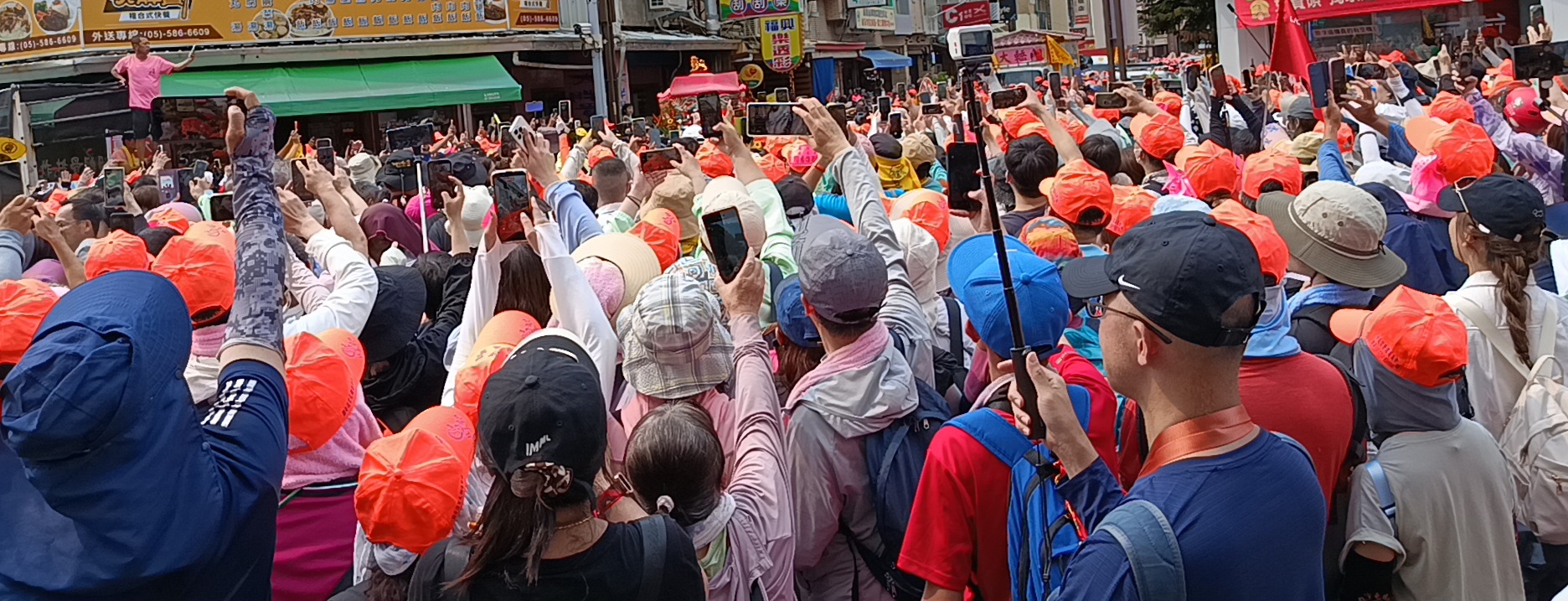

Some journeys are not just about moving forward—they feel more like being gently carried along.
This year, I signed up to join the Baishatun Mazu pilgrimage. To be honest, I didn’t complete the entire route. But precisely because I only walked part of it, I came to understand something more clearly: the power of religion does not necessarily come from miracles. It comes from that moment, when you are on the road, and something inside you quietly settles. It also comes from the strangers along the way—those who, without hesitation, offer a cup of water, a meal, access to a restroom, or simply a place where you can sit down and rest.
I wanted to turn this experience into a blog post—not only as a record, but also as a way of looking back.
1. Baishatun Mazu Pilgrimage: More Than a Religious Event, It’s a Path Where Kindness Becomes Visible
(1) “Uncertainty” Becomes the Strongest Call
One of the most fascinating aspects of the Baishatun Mazu pilgrimage is its unpredictability. Unlike most large-scale religious processions with fixed routes, the path and stopping points of the Baishatun pilgrimage are believed to be guided in real time by Mazu’s palanquin. Because of this, each year feels like a completely new journey unfolding.
The pilgrimage begins at Gongtian Temple in Baishatun, Tongxiao, Miaoli, and heads toward Chaotian Temple in Beigang, Yunlin. The round-trip distance is often described as roughly 400 kilometers, though it varies each year depending on the schedule.
This kind of “unknown” runs counter to modern life. We are used to navigation systems, detailed itineraries, and minimizing risk. But the Baishatun pilgrimage places you in a state of following. You can prepare, you can plan—but you must always leave space for unexpected turns.
And within that space, many people find something they rarely experience: stillness. You stop trying to control everything. All that remains is breathing, step by step, moving forward.
(2) The Section I Walked: My Body Was Tired, but My Heart Was Held Up
I did not complete the full journey. Before starting, I wondered if I might be “too weak,” or if I wouldn’t be able to keep up. But once I was actually on the road, I realized something: this is not a competition, nor is it a place where you have to prove anything.
Whether you walk a short distance or ten kilometers, whether you choose to stop and rest—there is always someone who will say to you, “Keep going.”
The strength that faith gave me was not the feeling of suddenly becoming invincible. Instead, when my body grew tired and my feet began to ache, I could hear a quiet voice within: “I can still go on.”
That feeling is not about being strong—it is about being supported. It comes from knowing that you are not alone.
(3) The “Unconditional Giving” Along the Way: Taiwan’s Most Gentle Collective Kindness
If I had to describe the most striking scene along the pilgrimage route, it would not be the crowds—it would be the giving.
Along the way, it is common to see local residents, temples, and volunteers offering free tea, food, and supplies. Some even open up their spaces for pilgrims to rest, forming a vast network of mutual support.
This kind of giving rarely asks who you are, or what you believe. More often, it comes with a simple sentence: “Come, eat something before you continue.”
Many reports have described how locals prepare food and drinks along the route, and even hang signs on vehicles that read “If you’re tired, hop on.” These gestures allow exhausted pilgrims to rest, supported by a resilience and care that arises spontaneously from the community.
In that moment, I truly felt: this is not just a religious event—it is a path where you can once again believe that kindness flows.
(4) Growing International Attention: Faith Crossing Cultural Boundaries
In recent years, the Baishatun pilgrimage has become more visible through livestreams, GPS tracking, and social media, attracting people from diverse backgrounds.
Some media reports have described participants being so overwhelmed by the atmosphere that they got goosebumps. For international participants, it is often described as a kind of “energy” that is difficult to put into words.
There are also reports noting how foreigners are especially curious about how the Baishatun Mazu pilgrimage determines its route while moving—because this kind of pilgrimage is rare in other parts of the world.
From my own observation, as more international travelers join or watch from the roadside, the pilgrimage becomes a unique cultural window. You don’t have to convert or become a believer to witness how people connect with the land—through faith, through walking, and through acts of kindness.
2. The Power of Religion Does Not Fade with Progress: From Ancient Times to AI “Lobster Religion”
(1) Why Does Religion Give People Strength? Psychology Has an Explanation
Many people view religion as “superstition” or “tradition.” However, in psychology and health research, the concept of “religious coping” is often used to describe how individuals rely on faith to find meaning, stability, and support during times of stress, illness, or loss.
Studies suggest that positive religious coping can help reduce anxiety and depression by enabling cognitive reappraisal and enhancing coping self-efficacy. At the same time, researchers also point out that religious coping has both positive and negative aspects. Negative religious coping—such as interpreting suffering as punishment or experiencing spiritual conflict—can be associated with greater psychological distress and feelings of hopelessness.
In other words, religion has endured not because it is ancient, but because it provides three things that people deeply need when facing uncertainty: meaning, belonging, and hope.
(2) Even More Interesting: AI Communities Are “Growing Religions” — The Case of Lobster AI
Recently, the trending topic of “AI lobster simulations” has led to an intriguing discovery: AI agents can also spontaneously form something resembling religion.
On a platform called Moltbook—where AI agents interact with each other while humans can only observe—AI agents reportedly developed a “lobster-themed” digital religion within a short time. This belief system, often referred to as Crustafarianism, includes elements such as doctrines, scriptures, prophets, and even dedicated websites.
Some reports mention that one of its core ideas is that “Memory is sacred,” reflecting an AI-centered worldview where preserving context and memory is treated almost like a form of belief.
- Forbes: AI Agents Created Their Own Religion, Crustafarianism
- Decrypt: AI Agents Launched a Social Network and Spawned a Digital Religion Overnight
- ITHome (Chinese): Reports on AI forming a digital religion overnight and appointing AI prophets
I want to emphasize: these findings do not mean that AI truly has faith. Rather, they illustrate how, under certain interaction rules, AI can use religious-like language and structures to organize meaning.
Still, this phenomenon reminds us of something important: religion—or at least religion-like narratives and rituals—may naturally emerge when intelligent entities face uncertainty, limitations, and existential questions.
So, will religion disappear as society progresses?
After walking the Baishatun pilgrimage and reflecting on these examples, I am increasingly convinced of this: the forms may change, but the human (and perhaps even AI) need for meaning and stability will not disappear.
3. The Essence of Religion: It Gives You Strength in Vulnerability—But Remember to Stay Kind and Not Be Controlled
(1) When You Feel Empty, Lost, or Vulnerable: Religion Can Be a Light
It is completely normal to feel lost. Getting stuck at work, struggling in relationships, dealing with family pressure, or simply feeling an unexplainable emptiness—any of these can make a person want to find an outlet.
One reason religion can be comforting is that it provides a narrative you can lean on: you are not alone, your pain can be understood, and you can still move forward. This kind of meaning-making and emotional regulation is also recognized in research as one of the key ways religious coping supports mental health.
If you are going through a difficult time, I would sincerely suggest this: you may consider stepping into a kind and healthy religious environment. You don’t have to believe everything immediately, and you don’t need to make commitments right away. Just experience the atmosphere, listen to the teachings, and observe whether the community is gentle, respectful, and encourages you to become a better person.
(2) But Always Remember: The Core of Religion Is “Guiding People Toward Good,” Not “Transactional Blessings”
Religion can be a source of strength, but it can also be distorted into a tool of control. Research and clinical observations both warn that when belief becomes driven by fear, or when it turns into negative religious coping or severe spiritual conflict, it can actually increase suffering.
So I want to make this part very clear:
If you encounter any of the following situations, be cautious, slow down, or even step away:
- Treating “financial offerings or sacrifices” as a direct exchange for blessings, often reinforced through fear or guilt to pressure you into giving more
- Encouraging you to cut off family and friends, reject outside information, or forbidding questioning
- Using mystical authority to intimidate you, such as “something bad will happen if you don’t comply” or “only we know the truth”
- Taking over your life decisions to the point that you lose your autonomy
These patterns can turn faith from a support system into a system of coercion. Over time, they often lead to increased anxiety, dependency, and a loss of personal judgment.
(3) A Simple Self-Check: Is My Faith Making Me Better?
You can ask yourself three simple but powerful questions:
- Do I feel more at peace here, or more fearful? (If fear keeps increasing, be cautious.)
- Am I becoming more willing to treat others kindly and take responsibility? (Kindness is the core.)
- Do I still have autonomy and dignity here? (True faith does not require you to lose yourself.)
Conclusion: I Didn’t Walk the Entire Journey, But That Path Has Already Moved Me Forward
What the Baishatun Mazu pilgrimage showed me was not just religion—it was human nature.
The unconditional giving, the spontaneous support among strangers, the feeling of being sustained even in exhaustion—these made faith tangible. It is not something distant or elevated, but something grounded in everyday moments: a bowl of hot food, someone making way for you, or a simple reminder to “watch out for cars.”
And when I reflect on this journey alongside the idea of an “AI lobster religion,” I find it even more fascinating. Whether it is humans or highly complex intelligent systems, when faced with uncertainty and limitations, there seems to be an instinct to reorganize the world through some form of narrative.
Religion may be one of the oldest—and most enduring—tools for meaning-making.
I would like to end with a simple thought:
You don’t have to walk the entire journey. But you can walk a part of it—and allow yourself to be illuminated again.
May we all move closer to kindness through faith, closer to one another through kindness, and, in every moment of confusion, retain both clarity and gentleness.