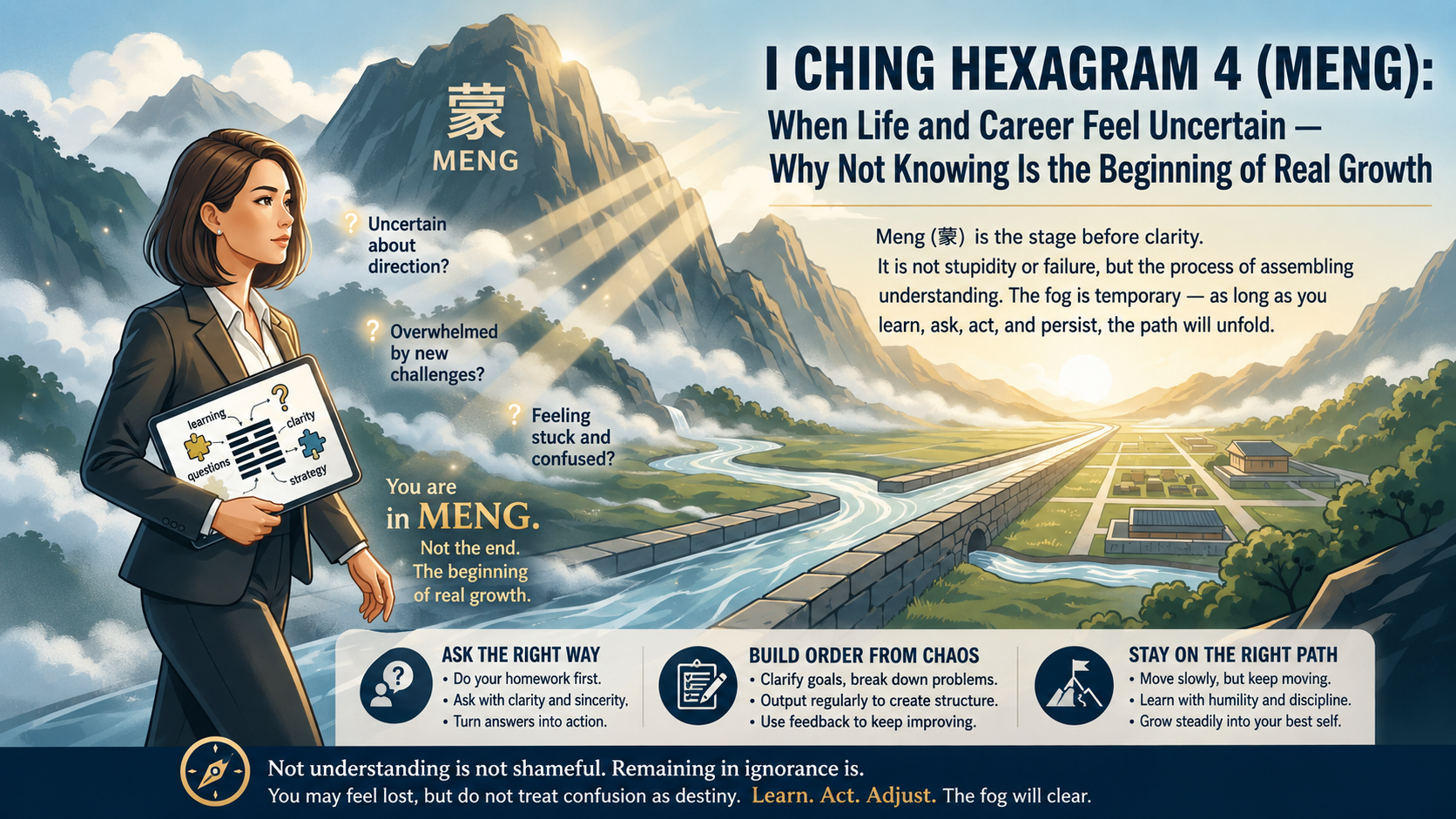

Some periods of feeling stuck are not caused by a lack of effort.
They happen because you are in a state called “Meng” (蒙) — a phase before clarity, a stage of still being on the path of learning.
It feels like this: you work every day, you keep pushing forward, yet you constantly feel as if you are walking through fog. Others seem to grasp the key point instantly from a single sentence, while you need repeated trial and exploration. Others appear confident and at ease, while you quietly wonder whether you lack ability — whether you are simply slower than everyone else by nature.
But in truth, Meng does not mean stupidity, nor does it mean failure. It is more like a period in which your understanding is still being assembled. You are piecing fragments together into a map: turning unfamiliar terms into concepts, scattered experiences into methods, and repeated setbacks into judgment and insight. The map is simply unfinished, so you cannot yet see the distant horizon — only the small stretch of road directly ahead.
What exhausts people most during this stage is often not the work itself, but the invisible anxiety surrounding it: the fear of asking questions and being judged, the fear of making mistakes and being laughed at, the fear that perhaps you are not as capable as you once believed. And deeper still is another fear — that days keep passing while you still do not know when things will finally get better.
The Meng Hexagram in the I Ching does not mock ignorance. Instead, it offers a reminder that is both gentle and strict: ignorance itself is not frightening; what is truly dangerous is refusing to learn, seeking answers carelessly, or mistaking confusion for destiny.
The greatest trap of Meng is not that you do not know — it is what you do when you do not know. People often try to fill the gap in the wrong ways: protecting pride instead of learning, chasing shortcuts instead of building foundations, denying themselves through emotion, or placing hope in someone else’s “perfect answer,” as if being shown the way could spare them the hardship of learning.
Yet the direction given by the Meng Hexagram is clear:
You may not understand — but you must be willing to learn.
You may feel confused — but you must learn how to ask questions.
You may move slowly — but you must stay on the right path.
True growth is never sudden enlightenment. It is the choice to create order within chaos: clarify the goal first, then break down the problem; attempt something before refining it; do one small thing correctly before stabilizing an entire method. One day, when you look back, you may realize that the foggiest period of your life was precisely when your abilities were forming their structural backbone.
So if you feel stuck recently — overwhelmed by unfinished work, uncertain about direction, constantly uneasy — it does not necessarily mean you are on the wrong path. You may simply have entered the stage of Meng. And what this hexagram teaches is not how to become strong immediately, but how to walk correctly, steadily, and far — even before understanding fully arrives.
1. Why Write About the Meng Hexagram? — Because Everyone Eventually Faces a Moment of “Not Knowing What to Do”
If you are experiencing any of the following situations, the Meng Hexagram may speak directly to you:
- You just changed jobs or received a promotion and suddenly feel like a beginner again.
- You were assigned a task you have never done before and feel insecure — afraid to ask, afraid to fail, afraid of being exposed.
- You work hard yet feel increasingly lost: unclear direction, unstable methods.
- You want further education or a career change, but information overload only increases anxiety.
- You are no longer a beginner, yet suddenly face a new field: AI, digital transformation, cross-department collaboration, leadership roles…
All of these resemble Meng: not failure, but the starting point of learning.
The Meng Hexagram is not concerned with whether you already know how — but with how to walk correctly and steadily while you still do not fully understand.
2. The Core Symbolism of the Meng Hexagram: A Spring Emerging — Cloudy Yet Guideable
The Meng Hexagram (Hexagram 4 of the I Ching) is formed by:
Mountain (Gen ☶) above
Water (Kan ☵) below
You can imagine it as:
- Water beneath a mountain — a spring emerging at its base.
- When spring water first appears, it carries mud and sediment, lacking clear direction.
- Yet once guided by channels, it flows toward clarity and nourishment.
Thus, Meng does not describe innate ignorance; it describes the chaotic phase of a beginner.
Chaos is not a fault.
It is the necessary precondition of every stage of growth.
A common workplace version of Meng looks like this:
You work extremely hard, but without structure or method, your effort resembles random shots fired in all directions.
The Meng Hexagram reminds us: establish order in learning first, and chaos will gradually become clarity.
3. Translating the Hexagram Text into Workplace Wisdom:
Learning How to Ask Matters More Than What You Ask
One of the most famous passages from the Meng Hexagram reads:
“Meng: Success.
It is not I who seek the ignorant youth; the ignorant youth seeks me.
At the first consultation, guidance is given.
Repeated questioning becomes disrespectful; then no guidance is given.
Perseverance in correctness brings benefit.”
Translated into workplace language, it means something very direct:
Ignorance can still lead to success — not understanding is acceptable as long as you follow the right learning path.
Learning requires initiative — mentors and seniors will not chase after you to teach; you must demonstrate genuine willingness to learn.
Ask once and receive direction; repeat the same question without reflection, and you lose the opportunity to be taught.
“First consultation” means sincere inquiry receives guidance.
“Repeated disrespect” means asking again and again without digestion, action, or effort — merely seeking ready-made answers — eventually discourages others from helping.
“Perseverance in correctness” means maintaining integrity during learning: honesty, diligence, discipline, and respect for fundamentals.
What does this mean in modern work environments?
- You may ask questions, but do your homework first.
- You may seek advice, but bring concrete problems and your preliminary thinking.
- You may feel confused, but do not use endless questioning as an excuse to avoid starting.
✅ The most welcomed way a newcomer asks questions:
“I’ve tried approaches A and B, and I’m currently stuck at X. Which part should I adjust first?”
❌ The fastest way to exhaust others’ patience:
“I don’t know how. Teach me.”
“So what do I do next?” (expecting guidance step by step without effort)
The Meng Hexagram does not tell you not to ask questions.
It teaches something deeper:
Asking questions is a skill — not a form of dependence.
4. The Six Lines of the Meng Hexagram: Six Stages from Beginner to Independence
What makes the I Ching remarkable is that it is not merely inspirational philosophy. It functions more like a map of human development.
The six lines of the Meng Hexagram describe six stages — a progression from confusion to clarity.

| Line | Original Text | Core Meaning |
|---|---|---|
| Top Nine | Striking ignorance. Not favorable to attack; favorable to defend. | Decisive correction: using appropriate firmness to break ignorance, focusing on protection and adjustment. |
| Six in the Fifth | Childlike ignorance brings good fortune. | Humility brings benefit: maintaining sincerity and openness allows natural growth. |
| Six in the Fourth | Confined in ignorance; regret. | Being trapped: isolation or lack of guidance leads to stagnation. |
| Six in the Third | Do not take the maiden; seeing wealth, one loses oneself. | Guard against temptation: confusion makes people prone to losing direction. |
| Nine in the Second | Embracing ignorance brings good fortune. | Tolerance and responsibility: strength combined with compassion enables leadership. |
| Initial Six | Dispelling ignorance through discipline. | Establish rules and structure to prevent going astray. |
Next, let us interpret these stages from a workplace perspective.
1) Initial Six — Awakening Ignorance: Build Rules Before Results
The first line focuses on beginning learning.
Its message is simple: establish boundaries and basic discipline first.
For newcomers entering a company, what matters most is not how quickly you produce results, but whether you have:
- Basic discipline: punctuality, reporting progress, documentation, delivery
- Basic processes: version control, data management, meeting records
- Basic attitude: ask when unsure — but research first; correct mistakes instead of making excuses
Early habits eventually become destiny.
The same applies to life.
Avoidance and procrastination formed during transitional periods often grow into major obstacles later.
The first step of Meng is therefore clear: lay a straight foundation.
2) Nine in the Second — Embracing Ignorance: Value Those Willing to Teach You
This line represents a mentor capable of embracing beginners.
If someone at work is willing to guide you, it usually means one of two things:
- They see your potential.
- They appreciate your attitude — reliability, willingness to learn, responsiveness.
Your responsibility is to make teaching you worthwhile. Practical ways include:
- After receiving guidance, organize it into notes or workflows so you do not ask the same question again.
- Transform what you learn into tangible results or improvements.
- Report back on outcomes after applying advice — whether successful or not.
Mentors are not meant to be depended upon.
They exist to shorten your exploration time.
Your actions must show that you are not there to drain their energy.
3) Six in the Third — Do Not Rush Toward Shortcuts
This line warns that during confusion, external temptations become especially strong.
In the workplace, this looks like:
- Chasing promotion tactics before mastering fundamentals
- Jumping industries before understanding one deeply
- Following glamorous paths without knowing what you truly want
The more confused a person feels, the more they seek a fast answer.
But the Meng Hexagram reminds us:
the greatest danger during confusion is not slowness — it is deviation.
✅ Healthy strategy: build compoundable skills (communication, writing, analysis, professional expertise)
❌ Risky strategy: pursue only what appears fastest (status, short-term gains, vanity labels)
4) Six in the Fourth — Being Trapped in Ignorance: Getting Stuck Is Normal
This line represents being stuck inside confusion.
You may feel that despite working hard:
- Progress seems invisible
- Results remain unstable
- You repeatedly start over
- Self-doubt reaches its peak
The message here is important: being stuck does not mean incompetence — it means you are crossing a threshold.
At this stage, the key is not greater effort, but better strategy:
- Break large problems into smaller ones — improve 1% today.
- Return to fundamentals: process, structure, priorities.
- Seek feedback from colleagues or supervisors.
- Make progress visible by documenting what you have done.
Many people quit careers, abandon transitions, or stop learning at this stage.
Yet often, persistence just a little longer leads to breakthrough.
5) Six in the Fifth — Childlike Ignorance Brings Good Fortune
This is one of the brightest lines in the hexagram.
“Childlike ignorance” does not mean immaturity. It means:
- Willingness to reset one’s mindset
- Absence of arrogance
- Not protecting ego at the expense of growth
- Maintaining curiosity and sincerity
In the workplace, the fastest learners are rarely the smartest — but those who can:
- Admit what they do not know
- Immediately fill the gap
- Organize learning into their own system
- Apply it independently next time
Beginner’s mind is not naïveté; it is an advanced learning capability.
“Childlike ignorance brings good fortune” suggests that those who learn well eventually become strong leaders.
6) Top Nine — Striking Ignorance: Confront Your Own Bad Habits
This final line speaks of correction, not aggression.
Once you are no longer a beginner, your opponent is no longer ignorance itself, but:
- Knowing yet refusing to change
- Having ability but lacking discipline
- Understanding principles but choosing shortcuts
- Knowing what must be done yet procrastinating
What you need now is firmness in self-management:
- Cut off destructive habits
- Use systems to control procrastination
- Turn goals into executable rhythms
- Transform values into decision standards
At the final stage, the Meng Hexagram teaches:
You are no longer fighting the world —
you are confronting the ignorance within yourself.
5. Applying the Meng Hexagram at Work: Three Practical Ways to Break Through Confusion
Method 1: Build a “Questioning SOP”
Use this structure when asking questions:
- My current understanding: ______
- My current progress: ______
- Methods I have tried: A / B / C
- Where I am stuck: ______
- What I need from you: direction / prioritization / risk advice
This approach produces high-quality answers instead of passive instruction.
Method 2: Replace Overthinking with Output
During the Meng stage, people often consume endlessly — reading, attending courses, collecting notes — without producing anything.
Break this pattern with one small output per week:
- Organize one workflow document
- Write one weekly reflection
- Create one presentation template
- Build one small automation (even a simple Excel improvement)
Output forces chaos into structure.
Method 3: Create Feedback Loops
Without feedback, you never know whether you remain confused or are progressing.
Schedule weekly feedback:
- What was the best thing I did this week?
- What is one thing I should improve?
- How would you like me to deliver work next week?
Feedback is not about pleasing others — it turns learning into a controllable system.
6. A Message for Those Feeling Lost: Meng Is Not a Flaw, but a Process That Eventually Blossoms
One of my favorite underlying attitudes of the Meng Hexagram is this:
Admitting that you are still learning is itself a form of maturity.
Life rarely ends after finding one answer; instead, we enter the next level of confusion:
- Promotion brings managerial uncertainty.
- Changing industries brings unfamiliar language and rules.
- Leading others introduces the complexity of human nature.
- Pursuing a better life creates new dilemmas of choice and trade-offs.
Confusion never disappears — but you become better at walking through it.
7. Three Questions to Ask Yourself
- Is my current confusion caused by lack of ability or lack of method?
- Are my recent questions promoting learning — or avoiding action?
- What long-term habit am I willing to build to break through confusion? (reading, output, feedback, practice)
Conclusion: One Sentence from the Meng Hexagram for Modern Professionals
Not understanding is not shameful. Remaining in ignorance is.
You may move slowly, but walk in the right direction.
You may ask questions, but bring thoughtfulness and sincerity.
You may feel lost, but do not treat confusion as destiny.
As long as you are willing to learn, act, and adjust, the fog will eventually clear — and one day you will realize that you can finally see the path ahead, and walk it with steady confidence.